![]() |
![]() |
![]() |
![]() |
|||
|
Genesis II
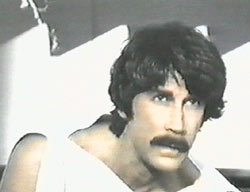
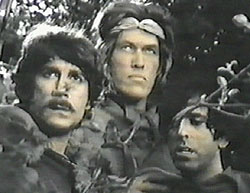
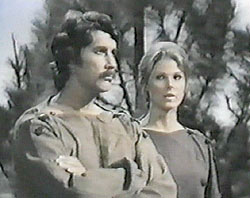
Dylan joins a band of 22nd century peacekeepers who utilize an underground tube system that rockets them to the far reaches of the planet to seek out strange new life forms, to boldly go where... (you get the idea).
"It had one thing in common with Star Trek and that was you could bring in a good writer and say to him, 'What bothers you about the world,' and go and invent a place in this new world and have it happen there."
A season's worth of scripts written primarily by Gene Roddenberry had Dylan and his travelling PAX Council encountering all manner of societal mutations: leaders of a poor village are drugging their people into subservience; Dylan falls through a portal into 1974 Manhattan and tries in vain to communicate with his past self through the girl he's fallen in love with; inhabitants of the Nevada desert are living life as presented in old TV western reruns; the PAX Council battles Company B, highly-trained commandos, awakened from the twentieth century, who were raised with no free will of their own.
"(CBS programmer Fred Silverman) thought the monkeys were so cute he cancelled Genesis II," Roddenberry lamented to an interviewer, "Several of us tried to warn him that it was a one time joke. He didn't listen and it was a disaster that cost them many millions of dollars."
ABC was interested in the concept so Roddenberry took Genesis II and reworked it slightly as Planet Earth, brought to life in a tele-film directed by Trek's Marc Daniels, starring John Saxon in the Dylan Hunt role (Alex Cord wasn't available).
The story, based on one of Roddenberry's Genesis II scripts, focused on a society dominated by women where men are kept as pets. Vastly inferior to the original, ABC aired Planet Earth to a hungry audience of Trekkies and was considering a regular slot for the series when creative conflicts left Roddenberry and ABC at odds. Joel Eisner,
author of The Official Batman Batbook tells us, "There was
a third version of Genesis II entitled Strange New World
(1976). It starred John Saxon, Keene Curtis and Kathleen Miller. It had
three scientists returning from outerspace to a post apoclypical earth.
The film was made up of two stories one taking place in the ruins of, I
believe, the San Diego Zoo, with the cast members caught in the middle when
the last surviving zoo game warden tries to protect the remaining animals
from poachers. The other had a city of androids and their human servants.
While Roddenberry's name wasn't on the pilot, it was still his film according
to Ted Cassidy. Having interviewed him a few months before his death, he
told me that he was offered the third film (he was in the first two) but
thought by this time the idea was stale and it wouldn't fly so he turned
it down."
Produced for Universal, Questor was basically Mr. Spock in a buddy show format. Cast in the lead role was none other than Leonard Nimoy, who posed in makeup for production photos and agreed to do the weekly series if Questor was picked up. Between script and shooting, Roddenberry inexplicably dumped Nimoy without bothering to tell the actor. In fact, Leonard Nimoy believed he was still attached to the project even after Robert Foxworth was hired for the role and only found out otherwise when he ran into Foxworth on the studio lot.
Instead of a spaceship, Questor and Dr. Jerry Robinson (played by Mike Farrell) could look out over the entire world from their high-tech "Information Center," spying on just about anybody in the world while videotaping their comings and goings. A private jet could get them to hotspots fast, but as with the "Prime Directive" from Trek, the artificial man could not interfere in the lives of humans in any significant way. The android's brainwaves were activated by tapes (just like the TRS-80) that come from a suspicious source, so the series would trace Questor's efforts to find out more about his creator.
Like Mr. Spock, humor would come from the android's inability to understand slang and a tendency to take things too literally. He had the ability to change his face to resemble others, but "lying will always be difficult for Questor since the logical answer to any question is the truth." Roddenberry's concept further detailed that "information is converted by Questor's computer mind into probabilities, not certainties. He can only estimate the odds on whether certain events will occur or not. His powers of observation are substantially better than human and his computer memory is that of total recall.
Since love, empathy, and hate cannot be computed, Questor is totally and completely dependent on Jerry Robinson to help guide him in such areas."Roddenberry actually began work on Questor in 1972 but passed it over to writer/producer Gene L. Coon (who was responsible for some of Star Trek's best scripts) so he could concentrate on Genesis II. Coon died in 1973 before the Questor script could be filmed. The series was green-lighted and slated for Friday nights at ten. That's right, the "timeslot of death," the same night and time that did in the original Star Trek. Once again Roddenberry was forced to battle NBC over changes large and small. For one, the network demanded that the Jerry Robinson character be dropped. They liked the show's overall concept, they insisted, they just wanted to tweak it a bit. Instead of being a two lead show, Questor should be centered around one character. The network took control of the show and re-wrote the writer's guide to make it more like The Fugitive, with the robot not only looking for his creator, but also on the run from "a five nation combine" of secret agents. "Questor is on the move," the new NBC format dictated, "He has no contacts with the human world. Questor cannot stand by and let a human be injured. The fact that he may give himself away by doing so becomes less important than the fact that he can't delay while a human dies." Basically, the complete opposite of the original idea. Farrell asked for and was granted a release from Questor to wisely take another series that was offered to him - M.A.S.H. Not wanting to work on what amounted to a tiresome chase series, Roddenberry reluctantly let the project languish. Ultimately unsatisfying, The Questor Tapes is still considered by many to be Roddenberry's best effort after Star Trek. In May, 1975 Roddenberry was brought in by Paramount to develop a possible Star Trek movie but his script was rejected and the project shelved. Gene worked on a pilot that year called The Nine, a bizarre, semi-autobiographical concoction that combined a screwed-up TV producer with a commune of telepathic creatures. This was another no-sale, as were Magna One, about a race of future people who live undersea and Battlefield Earth, which had humans living in "fat and happy" slavery under alien control. None of these storylines were fully realized, it would be two years before another Roddenberry concept made it to the screen. Preaching to the choir and passing the plate, Roddenberry recorded a record album in 1976, Inside Star Trek, where he expounded on Trek philosophy and history. He also talked about his battles with the NBC censors and his frustrating efforts to launch Questor and Genesis II. Further afield from his previous work, Spectre was created, written, and produced by Gene Roddenberry for airing on NBC May 21, 1977. This supernatural thriller starred Gig Young and Robert Culp as two paranormalists battling a great and powerful force plaguing a wealthy London financier. Directed by Clive Donner, Spectre had little in common with Star Trek or any previous Roddenberry project.
"I recently found something interesting about this film which I and several other film historians I know never knew. There was a European version of this film with extra footage and, in particular, nudity. It has always been known that many films added nude and violence for the European market. It was also known that many us TV movies were aired theatrically in England and Europe, but the addition of nudity to a TV movie is rare. In the case of this film, unknown, until recently when the Fox Movie Channel aired the film several times - mostly overnight - I hadn't seen the film for years and was surprised when I found that the print they were airing must have been the overseas version because of the several nude women that appeared in the black mass scene at the end of the film. Not just in the background but in full topless and bottomless (from the back) closeup. Not that it hurt the film, in fact, it made the scene less choppy as it originally appeared. I guess to cut out the nudity, they had to splice the scenes closer together. I hope they get around to releasing this version to disc." After Spectre, Gene Roddenberry gave up on getting another TV series off the ground. Star Wars hit the movie houses in 1977 and suddenly science-fiction was hot again. Star Trek fandom was a far-reaching, big business on its own and a revival of the series in some form was already in the works. At one point, it was announced that Star Trek would return in syndication with the original cast, but all of the sets would be miniatures, even the Enterprise interiors. To save production costs, the actors would be working entirely against a blue screen. This awful
idea never came about but in mid-'70s convention appearances, James Doohan
and others talked about a new series in development at Paramount called
Star Trek II. Subsequent television spin-offs and aggressive merchandising over the years have combined to make Roddenberry's creation one of the most valuable franchises in the world, more popular than it ever was in the '60s and '70s, securing his place in history as the Ray Kroc of outer-space. Gene Roddenberry, the visionary who kept his dream alive against all odds (with a little help from uncredited contributors, pills, pot, cocaine, alcohol, a massive ego, and the adulation of thousands) died on October 24, 1991 just a few days before fellow sci-fi producer Irwin Allen (Lost in Space) took his last flight to the stars.
|
Star
Trek -
Gene Roddenberry / Gene Roddenberry TV Shows / TV Blog / Classic TV Blog / 2007 New Fall TV Shows / Classic TV / I Love Lucy / Television Shows / TV on DVD / TV Shows on DVD / Prime Time TV / Television Blogs / TV Show Reviews / TV Shows on DVD Reviews / TV DVD Reviews / Amos and Andy on TV / Gene Roddenberry's Star Trek
Everything you're |
![]() |
![]() |
![]() |
![]() |
![]() |
![]() |
![]() |
|
|
||||||||||||||
| |
![]() Contact Us / Survey Other Cool TV Sites TV Blog |
|